
Fort Negley, Nashville’s Hilltop Site of War, Freedom and Memory |
Uncover the untold history of Nashville's historic Fort Negley and its pivotal role in war, freedom, and memory. |
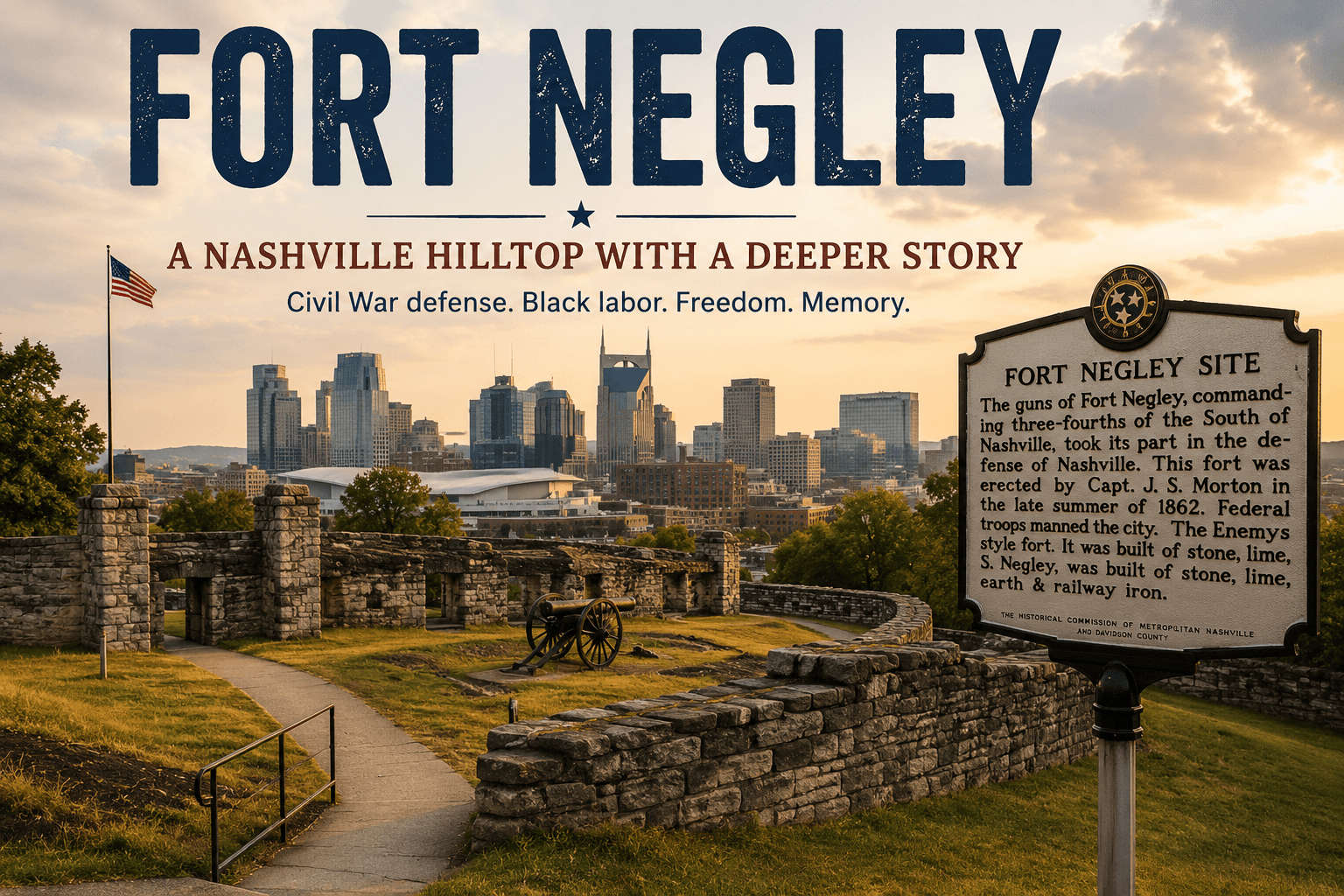
Just south of downtown Nashville, Fort Negley sits on St. Cloud Hill with wide views of the city skyline. From a distance, it can look like a quiet historic ruin. But the story behind those stone walls is one of Nashville’s most complicated and important.
Fort Negley was built in 1862 after Union forces occupied Nashville during the Civil War. It became the centerpiece of the city’s Federal defensive system and is recognized as the largest inland stone fortification built during the war. More than 2,700 workers, many of them free and formerly enslaved Black laborers, helped build the fort from August through December of that year.
That labor is central to Fort Negley’s meaning today. Many of the people who built the fort had fled slavery and moved toward Union lines, hoping for safety, freedom, work, and protection. Instead, they were put to work clearing the hill, cutting limestone, hauling stone, and building a massive military structure under difficult conditions. The National Park Service notes that workers used 62,500 cubic feet of stone to create the fortification.
Fort Negley was not attacked during the Battle of Nashville in December 1864, but its presence mattered. It represented Union control of the city and the military importance of Nashville as a transportation and supply hub. It also reflected a larger turning point: Black labor, Black soldiers, and formerly enslaved people were shaping the outcome of the war and the future of the city.
After the war, the fort’s story continued to evolve. It was restored by the Works Progress Administration in the 1930s, opened as a park in the early 1940s, later deteriorated, and remained closed for decades. The fort reopened to the public in 2004, and the Fort Negley Visitors Center opened in 2007 with exhibits and resources about occupied Nashville, the Civil War, and the site’s later history.
In 2019, Fort Negley was designated a UNESCO “Site of Memory” as part of the Slave Route Project, recognizing its connection to slavery, forced labor, freedom-seeking people, and public memory.
Today, Fort Negley is more than a place to take in a skyline view. It is a reminder that Nashville’s history includes struggle as well as growth, and that some of the city’s most meaningful landmarks are not the loudest or most polished. They are places that ask residents to slow down, look carefully, and remember who built the city — and at what cost.
For locals and newcomers, Fort Negley is worth visiting not only as a Civil War site, but as a place where Nashville’s stories of war, freedom, labor, preservation, and memory all meet on one hilltop. |
0 Comments
Join the conversation
Be the first to comment
Share your thoughts above.