Marathon Village, Nashville’s Old Auto Factory Turned Creative District |
Discover the transformative journey of Marathon Village, where history meets creativity in the heart of Nashville. |
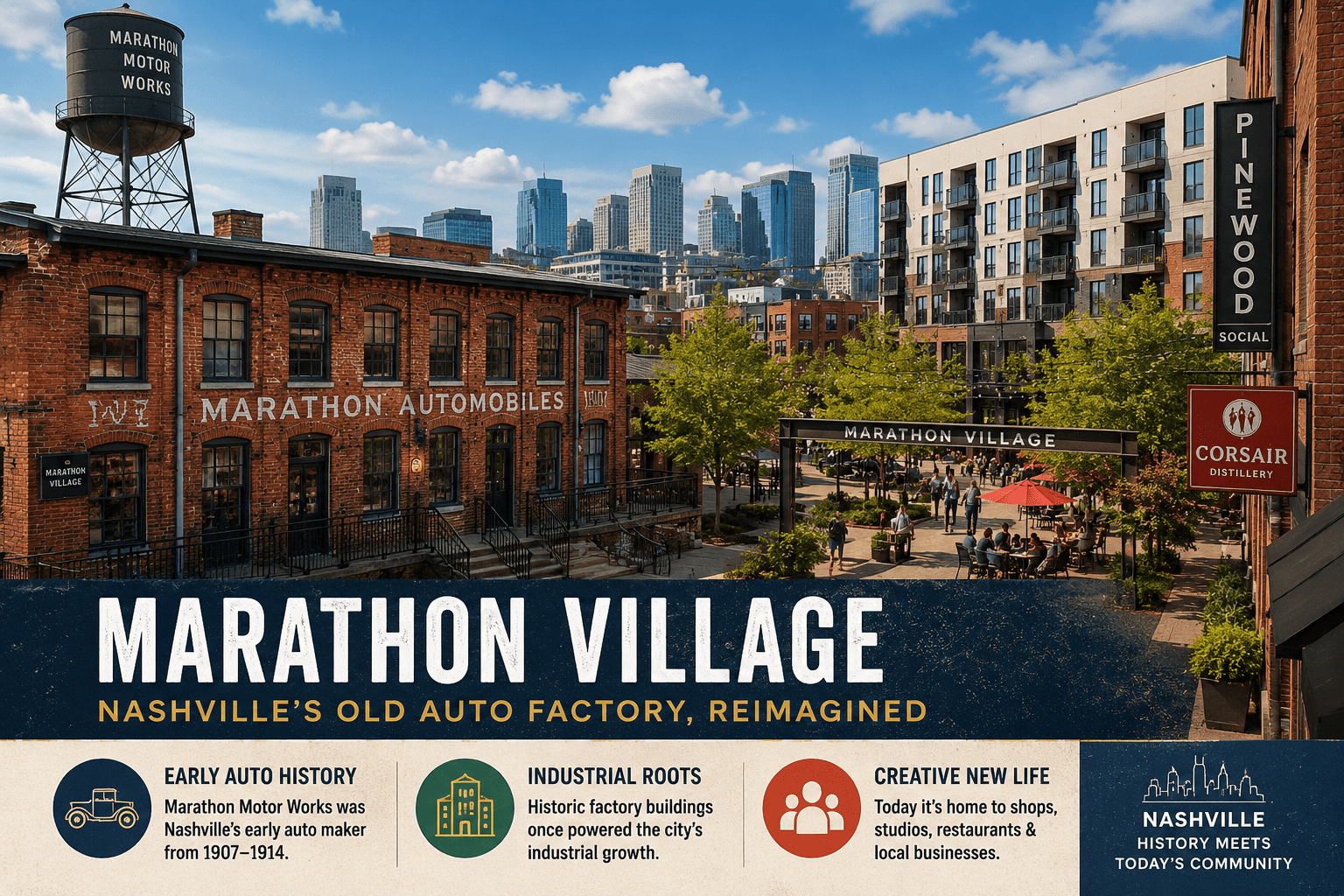
Before Marathon Village became a destination for shops, studios, distilleries, and local businesses, it was part of Nashville’s short-lived but fascinating automobile history.
The historic complex was once home to Marathon Motor Works, an early 20th-century automaker that helped put Nashville into the car-building business. Visit Music City describes Marathon Motor Works as the first automobile manufacturer in the South, operating from 1907 to 1914 before the buildings eventually found a second life.
The company’s story began with Southern Engine and Boiler Works, which originally produced industrial engines and boilers in Jackson, Tennessee. As the business moved into automobile production, the cars were first called “Southerns,” then renamed Marathon after the popularity of Greek-inspired themes following the 1904 Olympics. The Tennessee State Museum notes that Marathon Motor Works started producing cars in Jackson before the operation became tied to Nashville’s industrial story.
After relocating to Nashville, the company expanded the Marathon Motor Works buildings around the Clinton Street area. For a brief period, the factory represented ambition, innovation, and a very different side of Nashville’s economy — one built around machinery, manufacturing, and the hope that the city could become a serious player in the growing automobile industry.
But the momentum did not last. By 1914, Marathon Motor Works had faded, and the property eventually sat underused and deteriorating for decades. The official Marathon Village history says the old factory later served as a bag factory before falling into disrepair.
Today, the site tells a different kind of success story. Since renovations began in the late 1980s, the old industrial buildings have been transformed into Marathon Village, a creative community filled with shops, studios, food and drink spots, entertainment spaces, and local businesses. Visit Music City calls it a model for adaptive reuse, blending industrial history with new energy.
That mix of past and present is what makes Marathon Village worth noticing. It is not just a shopping stop or a tourist detour. It is a reminder that Nashville’s history includes factories as well as stages, assembly lines as well as songwriters, and old brick buildings that can still find new purpose.
For locals and newcomers, Marathon Village is one of those places where the city’s layers are easy to see: early manufacturing ambition, decades of decline, creative reinvention, and a new generation of small businesses keeping the old factory alive. |
0 Comments
Join the conversation
Be the first to comment
Share your thoughts above.